
One of the most common questions I hear before wisdom tooth extraction is,
"Doctor, is this a very difficult wisdom tooth?"
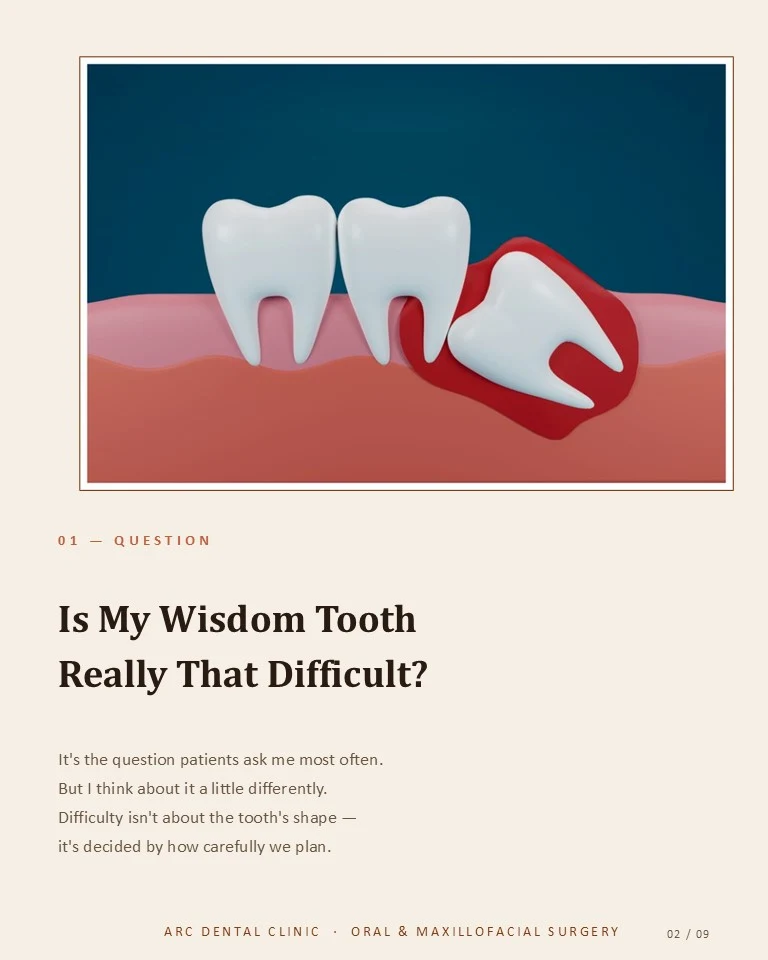
But every time I hear that question, I think a little differently.
Whether a wisdom tooth is difficult or not is not simply determined by the shape of the tooth.
I believe that how carefully the surgery is planned has a greater impact on the outcome.
That is why, before looking at the wisdom tooth, I always spend a long time studying the CT.
Patients sometimes smile and say,
"Doctor, you really look at the CT for a long time."
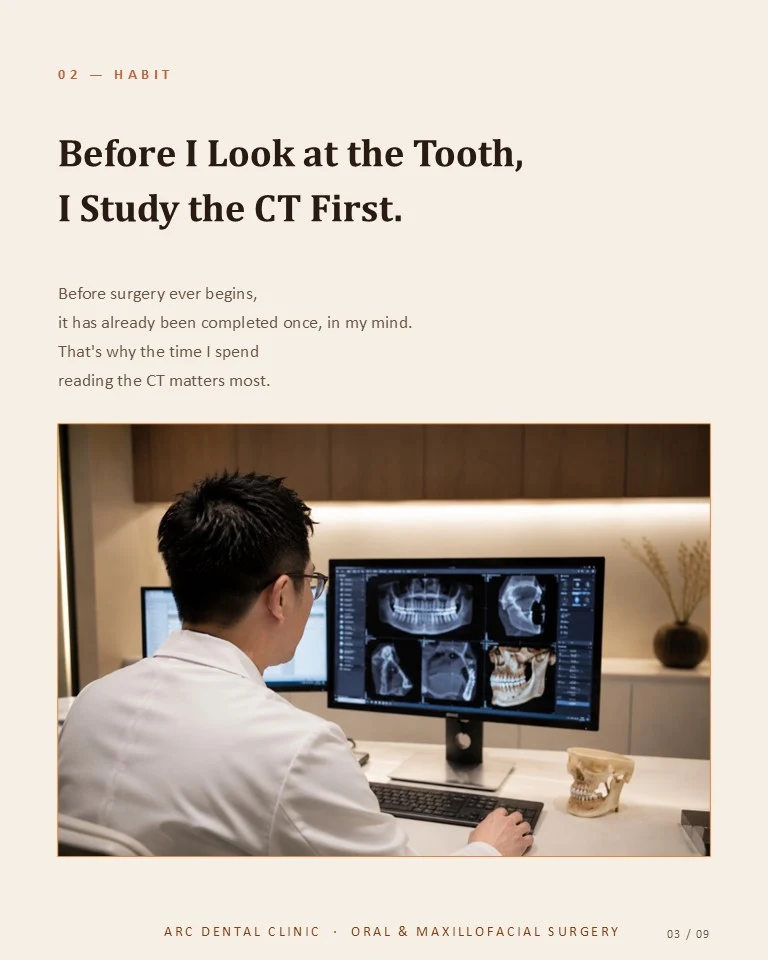
That is correct.
I believe that time is the most important part of the surgery.
Because before the surgery begins in the mouth,
the surgery must already be finished once in my mind.
CT is not a photograph; it is a map.
The reason I look at the CT is not simply to confirm where the wisdom tooth is located.
To me, the CT is a map of the surgery that will follow.
Where the nerve passes,
which direction the tooth is lying,
how much bone needs to be trimmed,
whether the tooth needs to be divided and removed.
I simulate all of these processes in my mind many times over.
Even wisdom teeth that look the same rarely receive the same plan.
What I learned most at the university hospital was not speed.
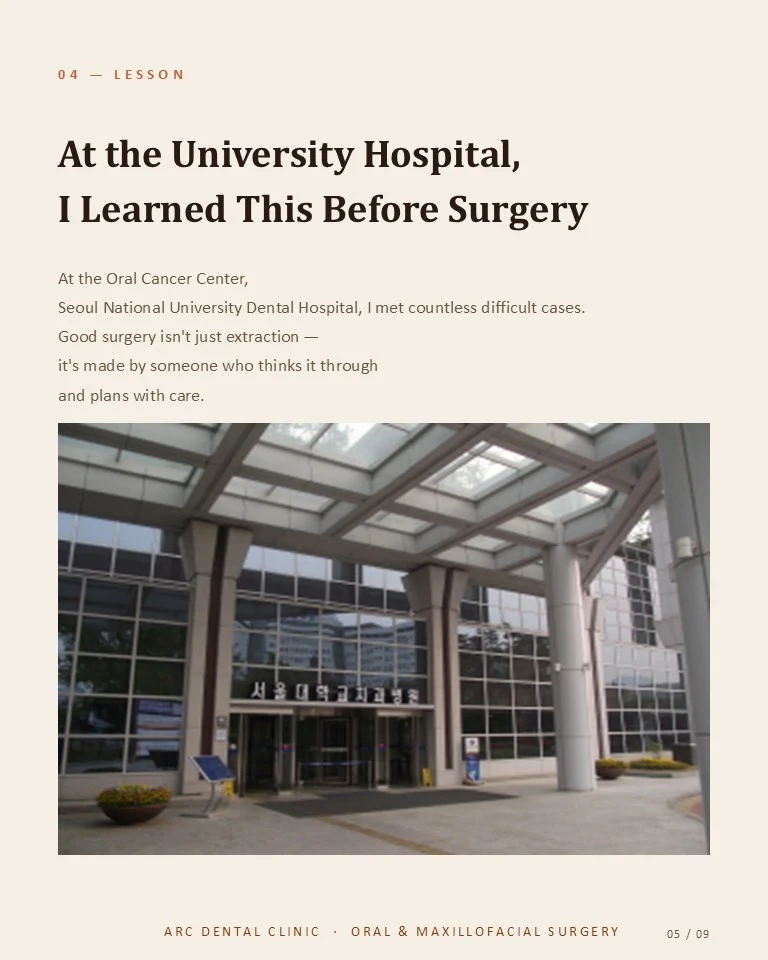
During my time at Seoul National University Dental Hospital, I frequently encountered high-difficulty wisdom teeth referred from other clinics.
Wisdom teeth very close to the nerve,
wisdom teeth deeply embedded in bone,
wisdom teeth growing backwards that make normal access difficult.
At first, I thought that experiencing many difficult surgeries was the greatest lesson.
But as time passed, I realized something slightly different.
Good surgery is not performed by those with quick hands, but by those who think sufficiently before starting.
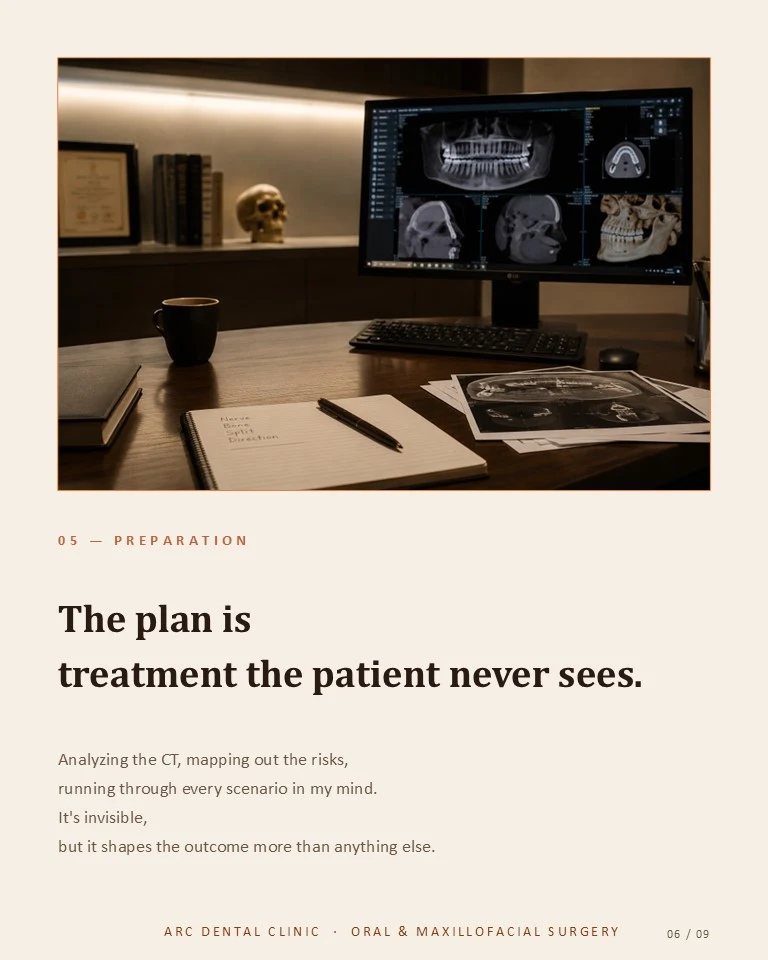
Planning is treatment that patients cannot see.
Patients may think that treatment begins the moment surgery starts.
But I believe treatment begins much earlier than that.
Analyzing the CT,
organizing anticipated risks,
repeating various possible situations in my mind to prepare.
That process is invisible to the eye,
but I believe it is the part that most greatly influences the result.
I do not think of all wisdom teeth as difficult.
There is also something interesting.
There are times when a wisdom tooth that I first thought, "This will not be easy today," turns out to be something the patient says, "It did not hurt at all."
Conversely, there are also cases where a straight, normally erupted wisdom tooth causes more discomfort than expected.
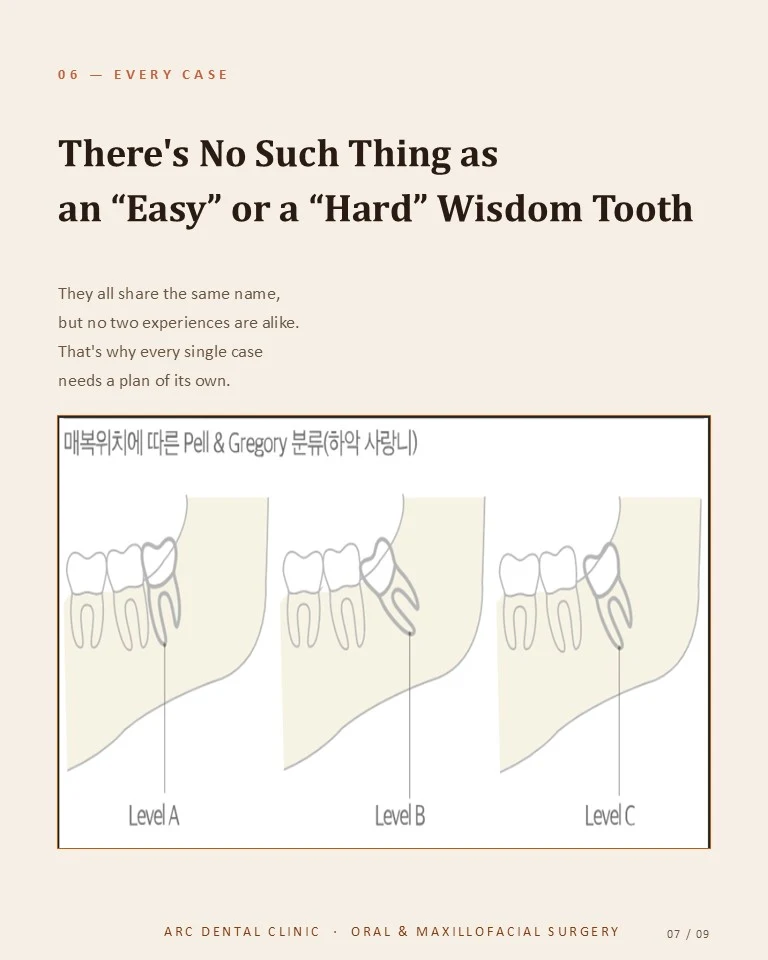
That is why I do not simply classify wisdom teeth as easy or difficult extractions.
I believe that each wisdom tooth requires its own plan.
What I value most is not the extraction, but the experience.
When patients leave the clinic, I feel the greatest sense of reward not when they say "It was extracted well," but when they say "It was more comfortable than I thought."
Dentistry is a place of tension for many people.
That is why I try to explain a little more,
wait a little longer,
and approach a little more carefully.
The success of surgery is not determined by the treatment outcome alone. I believe that how the patient remembers the treatment process is equally important.
Closing Note
Wisdom teeth all share the same name,
but no two wisdom teeth are the same.
That is why I still spend a long time looking at the CT today.
And before surgery begins, it has already started many times in my mind.
Jaeho Jeon
DDS · MD · PhD
Oral & Maxillofacial Surgeon
ARC Dental Clinic