It has hurt ever since I got the implant.
But the clinic that placed it
says it isn't actually because of the implant......
I just can't figure out the cause.......
The pain is so hard to bear......
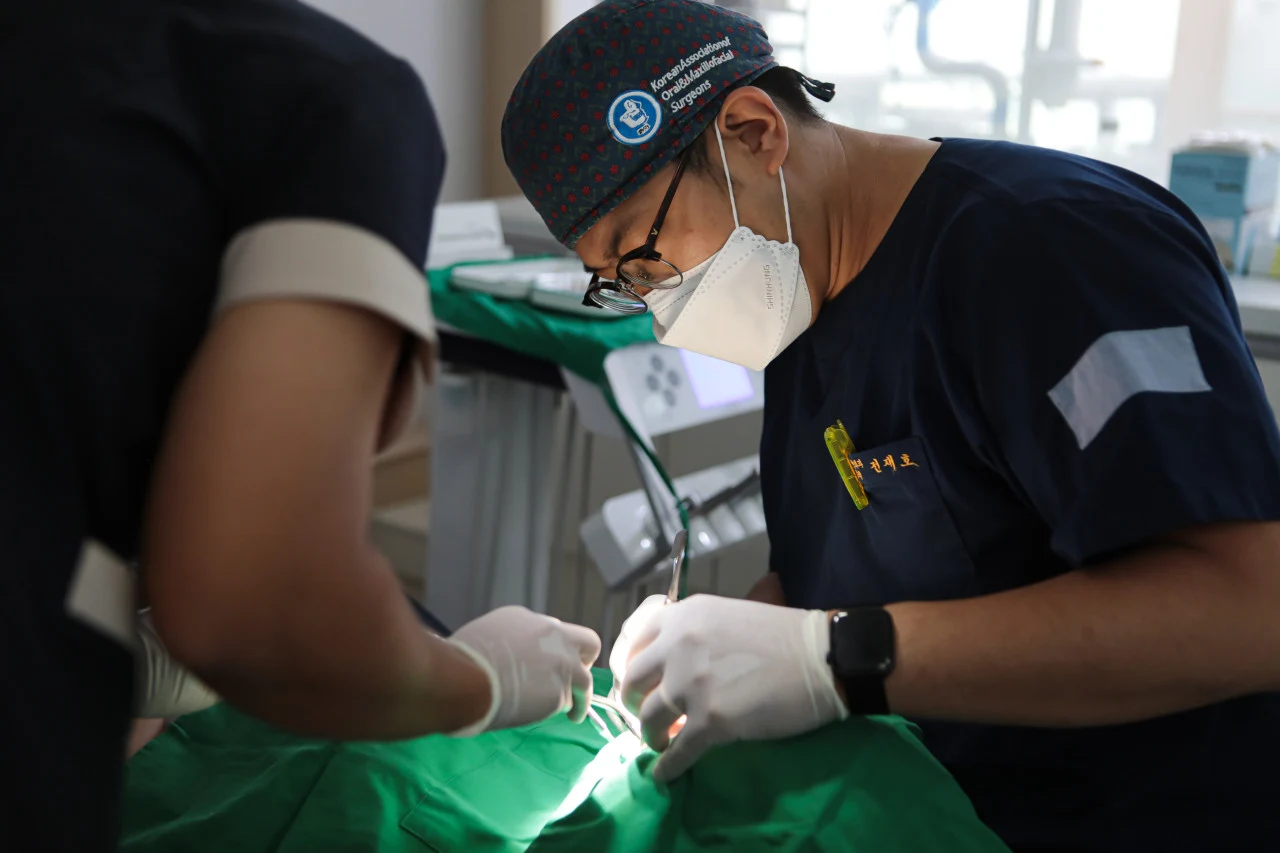
A while ago, an elderly patient came rushing into the Oral & Maxillofacial Surgery department at ARC Dental Clinic.
Even from the way he walked into the treatment room, something was clearly wrong. He was clutching one side of his jaw with his hand. Just looking at him, it was obvious he was in a great deal of pain.
He was not someone who had originally received implant treatment at our clinic.
The patient had not come from Seoul. He said he had come from Gangwon Province. We wondered how he had made it all the way from Gangwon to Gwanghwamun and Jongno here.
He said he had driven here himself on the highway. And of all days, the weather was unusually hot that day......
Thinking about how far he must have traveled to reach Seoul, my heart felt heavy. I found myself thinking of my own parents. When you're in pain, even going to a nearby clinic is hard — how frustrated and how much pain must he have been in, to travel from Gangwon to Seoul on such a hot day......
Hello.
This is Jaeho Jeon, Oral & Maxillofacial Surgeon at ARC Dental Clinic, located in Gwanghwamun, Euljiro, Jongno, and Myeongdong.
Specialist in Oral & Maxillofacial Surgery, Seoul National University / Visiting Professor of Oral & Maxillofacial Surgery, Seoul National University Dental Hospital.
Before I begin — if there are those among you who have had an implant and continue to be in pain or discomfort, I hope you won't just scroll past this article, and will give it a read at least once.
Today, as an Oral & Maxillofacial Surgeon, I would like to share a story that, honestly, weighs a little heavily on my heart.
The road he had to travel back and forth between Gangwon and Seoul on the highway because of implant pain
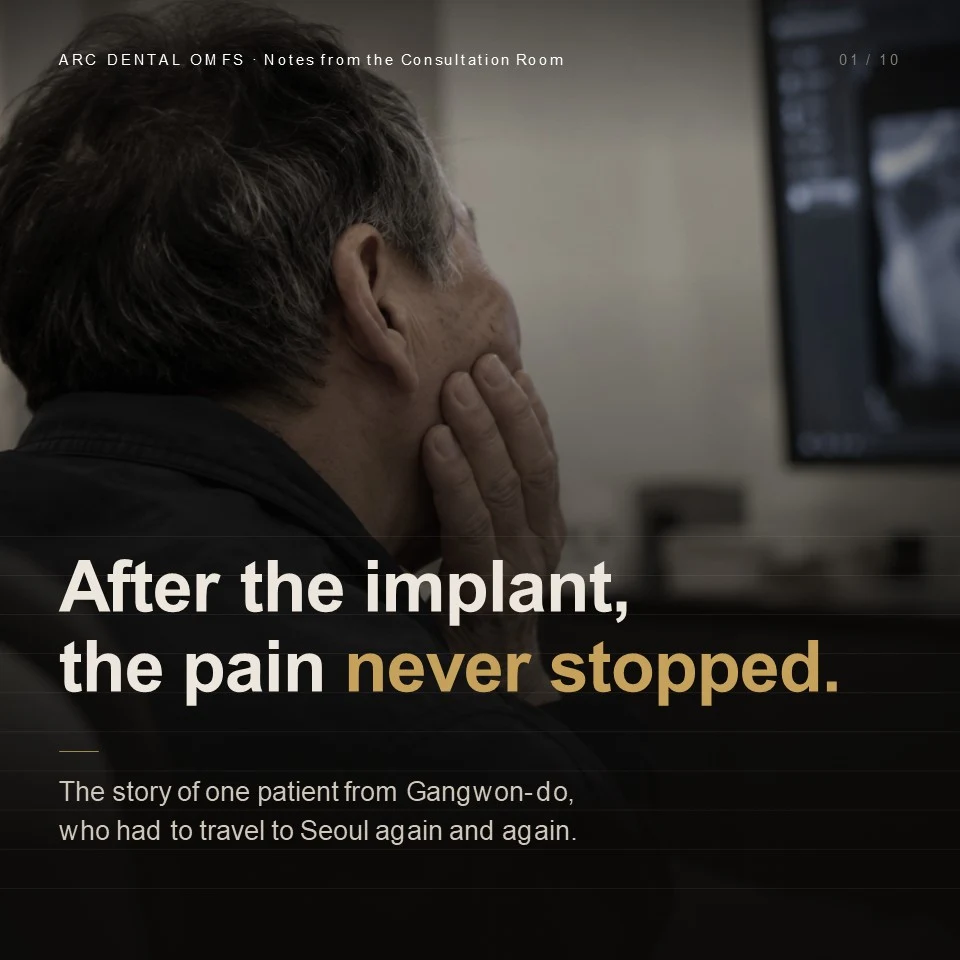
Today's story is about a patient who, because of severe pain that began after an implant was placed, went through several clinics and eventually ended up in our treatment room.
If there is anyone out there struggling with continuing pain after an implant, I hope you won't just think "I suppose implant surgery is just painful" and endure it for too long.
In particular, if it only improves briefly when you take medication and then hurts again, or if the pain doesn't ease even with time, I hope you won't just let it go and will have it checked once more.
Pain after an implant can have many causes, so this doesn't mean every pain is a problem. But there is definitely pain for which enduring it is not the answer.
The patient I'm about to tell you about is exactly that kind of case.
The time spent going through several departments to find the cause of the pain
When treating revision implant patients, there are cases where I think, "What if they had come just a little earlier?" This patient was one of them.
He said he had come all the way to Seoul looking for a lower-cost implant. I listened to his story slowly.
While looking into implant costs, he came to know of a large dental clinic in Seoul where he could receive treatment. Disregarding the long distance, he came from Gangwon to Seoul to have the implant surgery.
But the problem began the very next day after the implant was placed. He said the surgical site hurt terribly.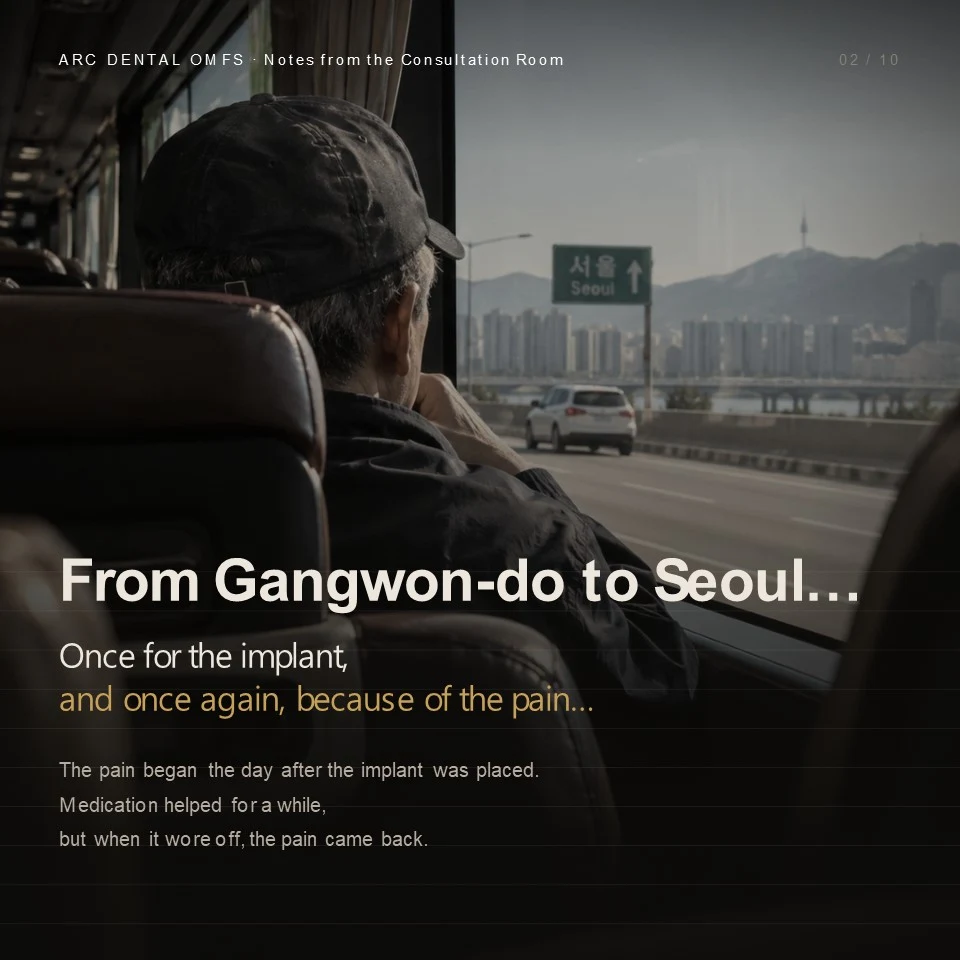
At first, the patient also thought, "I had implant surgery, so I suppose this much pain is normal," and waited. When he took the medication prescribed after surgery, it seemed to get a little better.
But just as the medication wore off, the pain rose again. Take the medicine and it improves a little, the medicine wears off and it hurts again...... He thought it would get better if he endured just a few days, but the pain hardly subsided.
In the end, the patient got back on the highway and came up to Seoul again. It was to revisit the clinic where he had first received the implant surgery.
From Gangwon to Seoul. Once to get the implant, and again because of the pain. But unfortunately, this patient's long journey did not end there.......
Coming to our clinic because of implant pain
At the clinic where he had received the implant surgery, he said they told him to try the Department of Oral Medicine. At Oral Medicine, they said the implant site seemed to have a problem, so he should go to Oral & Maxillofacial Surgery — and after going around and around, the patient finally ended up at our clinic.
First, I looked at where it hurt.
The patient sat down in the treatment chair. He looked very exhausted.
So I asked him again from the beginning. When the implant had been placed, when the pain had started, which area hurt, and how it changed when he took medication. Then I took a panoramic X-ray. I looked at the image together with the patient.
Looking at the image, there was something that was hard to overlook. When I examined the area the patient said was painful together with the position where the implant had been placed, I felt I needed to first check the relationship between the implant and the surrounding nerves.
There were parts that needed to be checked rather than simply viewing the patient's pain as "pain that can arise after surgery." In cases like this, experience matters.
You have to listen to when, where, and how the patient has been in pain, and approach it surgically while looking at the surgical site and the surrounding anatomical structures together.
You must have been in so much pain......
Looking at the X-ray together with the oral condition, I explained things to the patient one by one.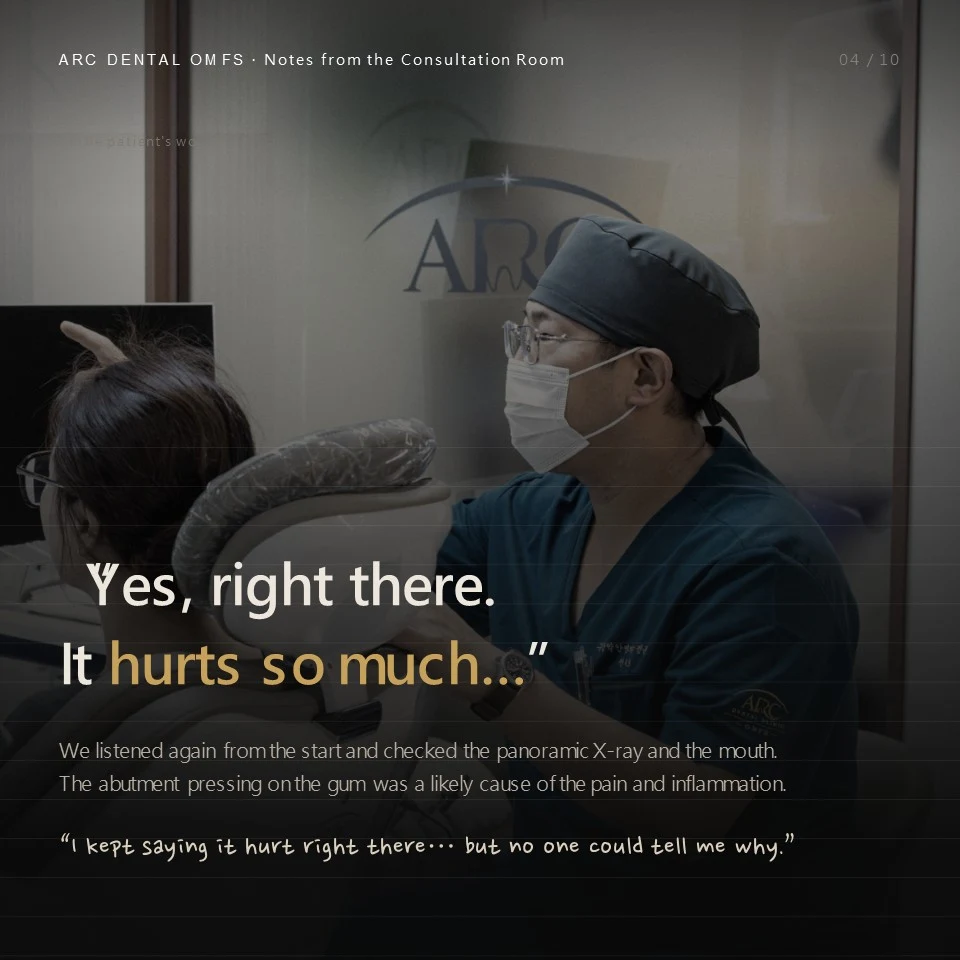
"This is the part that hurts a lot right now, isn't it?"
The implant abutment appeared to be excessively pressing on the surrounding gum, and I told him that we should first consider the possibility that the current pain and inflammation were related to this area. At that, the patient said right away:
"Ah, that's right. That spot really hurts so much."
And he continued talking for a while.
"I kept telling them that it hurt right there... and everyone just said they weren't sure...."
As he said this, he seemed a little relieved.
The pain hadn't suddenly disappeared, and treatment hadn't even begun yet. Even so, it seemed that just having someone now look together at the spot he kept saying hurt, and tell him about it, put his mind a little at ease. Seeing that, I felt something very strange.
Perhaps what the patient wanted from the beginning wasn't anything grand.
"I'm really in pain." To have someone truly listen to that once, look again at where it hurts, and explain why it might be so. Perhaps that came first.
So I told him as well.
"You must have been in so much pain. This level of pain isn't something you should just endure."
I wondered how stifled he must have felt all that time.
Traveling back and forth between Gangwon and Seoul several times, he must have explained where it hurt again and again — yet he arrived here without ever getting a clear answer about the very spot he felt hurt the most.
How much pain and frustration must he have felt. Thinking about how he endured that pain in the hot weather, going back and forth between Gangwon and Seoul several times, my heart was truly not at ease.
What was the cause of the patient's continued pain after implant surgery?
Looking at the panoramic X-ray together with the oral condition, I was able to identify the cause of the pain after implant surgery.
The implant abutment appeared to be excessively pressing on the surrounding gum, that is, the gingiva.
Simply put, the structure connected to the top of the implant was pressing too hard on the surrounding gum, and this was a situation in which we could first consider the possibility that continuous pain and inflammation had developed in that area.
It was also hard to overlook the fact that the patient had complained of continuous pain from right after the implant surgery. Taking medication reduced the pain for a while, but when the medication wore off it hurt again, and the pain did not subside over time.
Rather than continuing to wait, thinking "it's normal to hurt because I got an implant," I judged that this was a situation in which the condition of the gum around the implant needed to be re-examined first.
In particular, if pain continues after implant treatment, it is necessary to look not only at the implant itself, but also at the relationship between the abutment and the surrounding gingiva, the presence of inflammation, the bite, and various other possibilities together.
In this patient's case as well, when combining the current findings and symptoms, I suspected first and foremost gingival compression caused by the abutment, and the resulting inflammation and pain.
The nature of the pain the patient described
I also examined the nature of the pain the patient described. The pain had started the very next day after the implant was placed, and it would improve briefly when he took medication, then become severe again. He said the pain did not stay only in the area where the implant was placed, but felt as though it extended from around the jaw up toward the head.
The pain the patient felt was too great to simply think of it as pain that appears after implant surgery and keep enduring it. Before thinking of it as atypical pain, it seemed necessary to first re-examine the relationship between the implant and the nerves and surrounding tissues.
So I told him.
"Taking medication may relieve it for a while. But rather than just suppressing the pain with medication and waiting, I think we need to first check the parts that could be the cause."
And I gave him the opinion that, in the current state, he should promptly be re-evaluated at the medical institution where the surgery had been performed, and if necessary, removal of the placed implant should be considered.
"Then can't you just do it here quickly?"
But the patient said to us, "Then can't you just do it here quickly?" Listening to those words, my heart felt very heavy.
From the patient's perspective, it was only natural. He had come all this way, he had heard an explanation of why it hurt, and above all, he just wanted it to stop hurting now. We also wished we could resolve it right away if possible.
However, the patient had already begun implant treatment at an existing medical institution and had already paid the treatment costs. If we started treatment again at ARC Dental Clinic's Oral & Maxillofacial Surgery, the patient would have to bear the cost once more and might have to restart the entire treatment process from the beginning.
Above all, what was needed now was not to place one more new implant, but to resolve the cause of the current pain first.
So we could not tell him to unconditionally receive treatment again at our clinic. I thought that having the clinic that had performed the first surgery re-check the current state and receive the necessary treatment first was the way to reduce the patient's burden. So we had no choice but to send him back.
My heart felt very uneasy. Telling someone who had come all the way here from Gangwon to go back that long way again was not easy. Yet we could not simply send a person in pain away either.
So what did I do? I wrote a letter. To that clinic...
So that the patient's current state could be accurately conveyed when he returned to the clinic where he had first received surgery, I decided to write down the opinion to be delivered to the medical staff myself.
I did not want the patient to have to go back alone and explain from the beginning, saying "It still hurts." "It really hurts a lot." So I wrote a referral opinion to be delivered to the medical staff who had performed the surgery.
It was not a grand letter. It stated that rather than viewing the pain the patient complained of merely as atypical pain, they should once more carefully check the relationship between the currently placed implant and the surrounding nerves and tissues. It also included the opinion that, if the pain continued as it was, rather than merely controlling the pain with medication and waiting, they needed to re-evaluate the cause and decide on the necessary treatment as soon as possible.
It wasn't a grand letter. I simply hoped that when the patient made that long journey again, this time his pain would not be passed over. I hoped they would look just once more, in detail, at why he was in so much pain. I wrote it with just that feeling.
The patient took the letter and went back.
He has not come back to our clinic since that day. So we do not know what treatment he received afterward, or whether the pain has improved now.
I only hope that he was properly checked again at the place where he first received surgery, received the necessary treatment, and has by now escaped that long pain.
From Gangwon to Seoul..... I hope the patient, who traveled back and forth on the highway several times in pain, will no longer have to make that journey because of his teeth.
Even after the day's treatment ended, he stayed on my mind for quite a while. And because of him, I am writing this article today.
If there is anyone out there who continues to be in pain after getting an implant but has been enduring it, thinking "it must just be like that," I hope you won't endure it for too long.
Pain after implant surgery can have many causes. This does not mean every pain is a problem with the implant, and not every case requires removing the implant. But one thing is certain: it is worth checking whether there is a reason behind continuing pain.
And revision implant surgery does not begin with simply removing and re-placing. ARC Dental Clinic's Oral & Maxillofacial Surgery begins by finding why it hurts, why the problem arose — by finding the cause.
Implant surgery should be demanding. Then when is revision implant surgery needed?
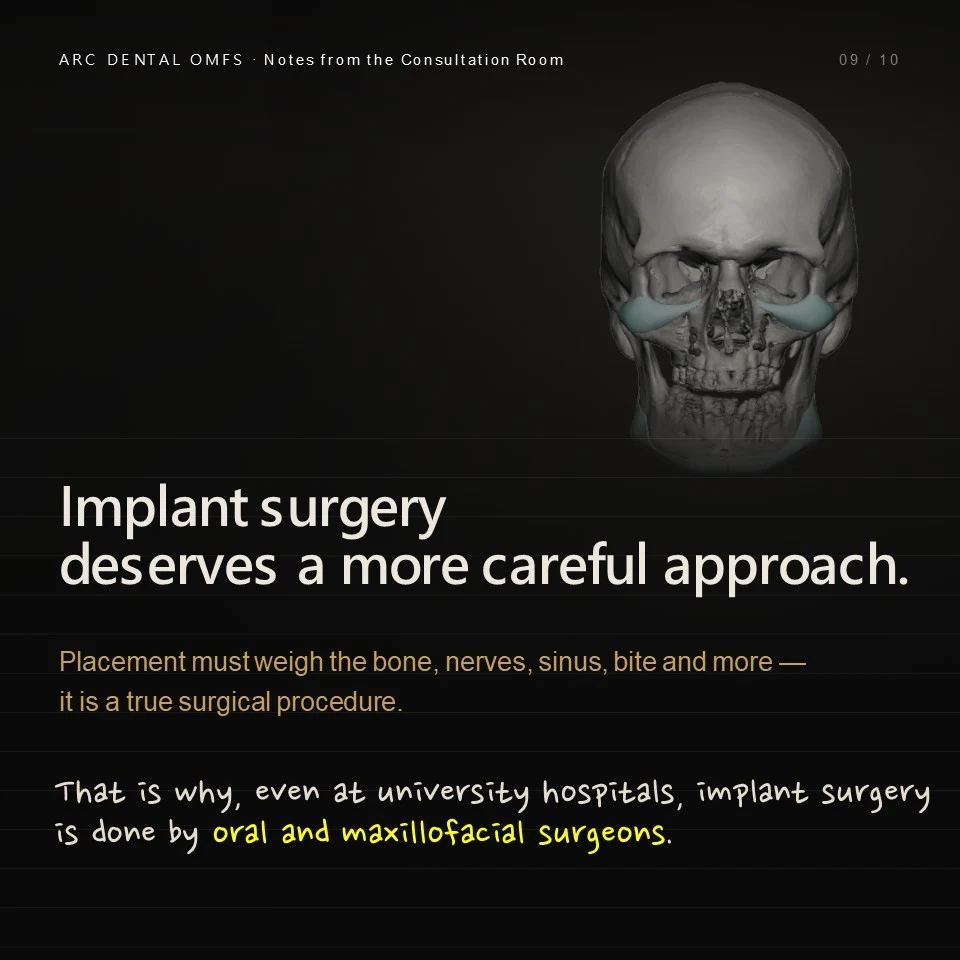
When people hear "revision implant surgery," many first think of 'removing the existing implant and placing a new one.' But in the actual treatment room, it is not that simple.
It is not about unconditionally removing it just because it hurts, nor unconditionally re-placing it just because there is a problem. We first check whether the implant currently in use can be saved.
Whether inflammation has developed around the implant, whether the jawbone is being lost, whether there is a problem with the position or direction of the implant placement, whether the abutment or prosthesis is excessively pressing on the surrounding gum, whether the chewing force is excessively concentrated on one side, and whether the relationship with surrounding structures such as nerves or the maxillary sinus is fine. Even for the same 'implant pain,' the causes can differ.
So in revision implant surgery, rather than 'how to re-place it,' we must first find out 'why the original implant developed a problem.'
Not everyone with pain around the implant site undergoes revision surgery.
I really want to say this. Just because the area around the implant hurts does not mean every implant must be removed.
If the cause lies in the prosthesis or the abutment, there are cases that can be resolved by adjusting or replacing that part; and if it is early inflammation around the implant, there are cases where the existing implant can be maintained while controlling the inflammation and treating the surrounding tissues.
Conversely, if bone loss around the implant is severe, if the position of the implant itself is poor, or if it is judged difficult to maintain the existing implant due to continuous infection and so on, removal of the implant and revision surgery may need to be considered.
There is only one thing that matters. Not unconditionally removing even an implant that can be saved. And not leaving an implant that must be removed in place without reason. That judgment comes first.
Peri-implantitis — if it starts to hurt, don't just let it go!
Shortly after implant placement, or after some time has passed, there are not a few cases where the area around the implant aches a little, then improves, then suddenly hurts a lot one day — that is, cases with that kind of similar pattern of pain. Many people call this peri-implantitis.
Peri-implantitis is a disease in which inflammation develops in the gum and jawbone around the implant. At first it may begin with the gum around the implant swelling or bleeding. But as the inflammation deepens, it can lead to pus, pain when chewing, bad breath, or loss of the jawbone around the implant.
In particular, if the area around the implant keeps swelling and hurting, if it bleeds when brushing, if pus is visible, or if chewing feels different from before, it is best not to just wait.
If a lot of the bone around the implant has already been lost, it may be difficult to resolve with simple gum treatment alone, and depending on the condition, one must judge whether the existing implant can be maintained or whether removal and revision implant surgery are needed.
What matters in treating peri-implantitis is not unconditionally removing the painful implant, but precisely checking how far the inflammation has progressed. If it can be saved, save it as much as possible; if it is difficult to maintain, confirm why removal is needed, and then plan whether to re-place the implant and whether bone grafting is needed.
If you remove the implant, can you re-place it right away?
When consulting about revision implant surgery, this is one of the questions I get the most. "Doctor, so can't you just remove it and re-place it right away?"
Yes. There are cases where it is possible. But it is not possible for every patient. After removing the existing implant, one must check the amount and condition of the remaining jawbone, the degree of inflammation and infection around it, the position where the implant was, and the distance to nerves or the maxillary sinus.
If the conditions are fine, re-placement can be considered at the same time as removal, but if the inflammation is severe or a lot of bone has been lost, it may be more appropriate to remove the existing implant, allow sufficient recovery, and then plan bone grafting and implant re-placement in stages.
So revision implant surgery is not simply 'one more placement surgery.' It is closer to treatment that re-examines why the first attempt failed, so that the same problem does not arise twice.
So I would dare say that revision implant surgery is far more demanding. Haha. And that is why an Oral & Maxillofacial Surgeon is needed.
If you are looking for a clinic in Seoul for revision implant surgery
If you are looking into clinics in Seoul for revision implant surgery, you have probably already been through a difficult time once.
When first looking into implants, price is what catches the eye first. Comparing prices itself is not wrong.
However, while treating revision implant patients, there are things I hope you will check together.
Whether the surrounding structures such as the jawbone, nerves, and maxillary sinus are sufficiently checked before surgery; whether the cause is looked for again when pain continues after surgery; by what standard they judge whether to save or remove the existing implant; and, if revision surgery is needed, whether they check even why the problem arose in the first place and plan again.
Because an implant is not a treatment that ends on the single day of surgery.
At ARC Dental Clinic's Oral & Maxillofacial Surgery in Gwanghwamun, we do not treat even those who come for revision implant consultation with the premise of 'remove and re-place' from the start.
What ARC Dental Clinic's Oral & Maxillofacial Surgery looks at first in revision implant surgery
At ARC Dental Clinic's Oral & Maxillofacial Surgery in Gwanghwamun, even if you come for revision implant consultation, we do not treat you with the premise of 'remove and re-place' from the start. We first check whether the existing implant can be saved. And if removal is needed, we consider it important to explain from the start why it must be removed.
The position and direction of the existing implant, the condition of the surrounding gum and jawbone, whether there is inflammation and bone loss, the condition of the abutment and prosthesis, surrounding anatomical structures such as nerves and the maxillary sinus, and the patient's systemic diseases and current medications. After checking each necessary part one by one, we then decide on treatment.
In particular, if you have already been through a difficult time with implant treatment once, the second treatment is bound to be more careful. This is exactly what patients who have had a bad experience after implant placement worry about the most. "What if it fails again...... What if I suffer again because of the implant....." Because we understand the patients' feelings well, we try to approach it even more carefully.
So what we consider important in revision implant surgery is not only the single skill of 're-placing.' Finding out why the problem arose, and planning so that the same problem does not arise again. I believe that comes first.
When first getting an implant, price can be an important criterion. But once a problem arises, what patients say to us the most was not about price.
"This time, I want to do it properly."
We hear that a lot. So we look even more carefully. In rebuilding a collapsed tooth, there needs to be a standard that does not collapse.
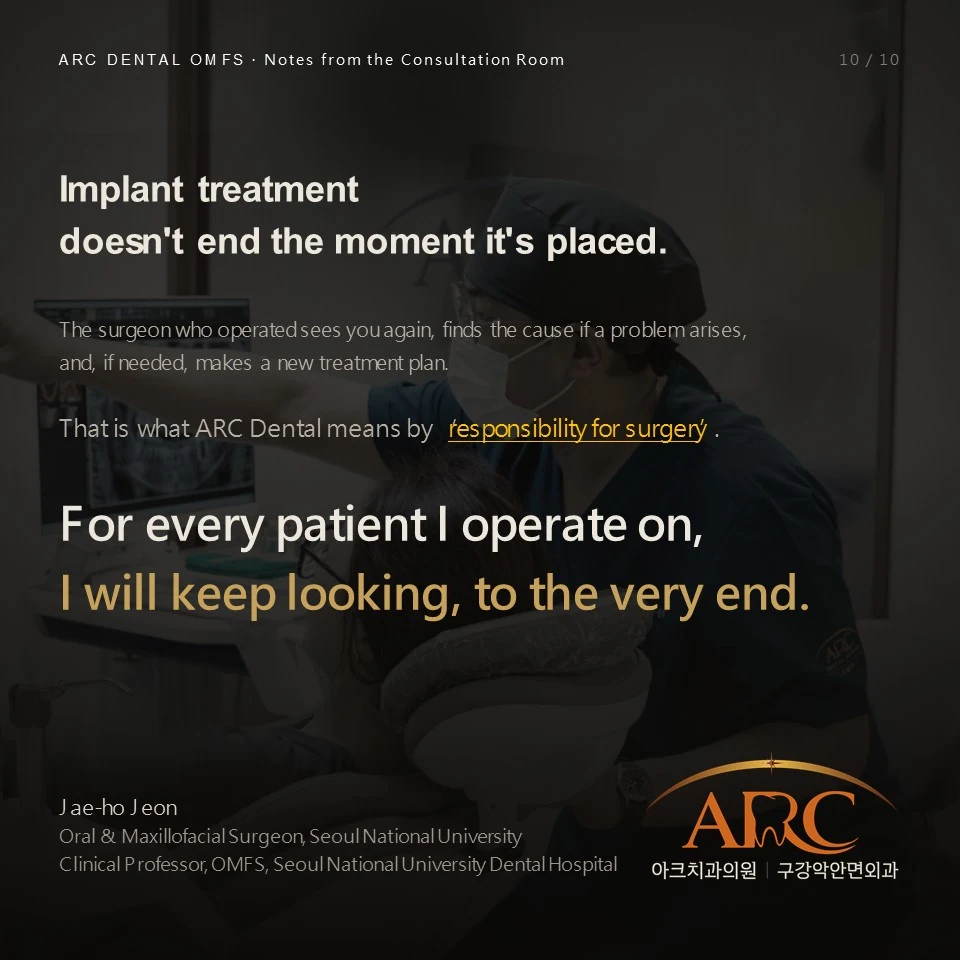
An implant is not a treatment that ends the moment it is placed.
Treating this patient, I thought once again. Placing an implant well is also important. But we consider it just as important who looks at the process after surgery.
Whether the patient is in more pain than expected after surgery, whether it is healing well, if a problem arose, why, and by what method it should be resolved when a problem arises. We consider this process to be part of implant surgery.
At ARC Dental Clinic, we do not want it to happen that when a patient develops a problem after implant surgery, they end up being treated by someone else. The surgeon who operated looks again, the surgeon who operated checks the cause, and if necessary re-establishes the treatment plan. That is what we consider 'responsibility for surgery.'
Of course, medicine can have unexpected variables and no result can be guaranteed. But I believe we must not ignore a patient's story or turn away from the process after surgery just because a problem arose.
From the day the implant is first placed, through the recovery and management afterward. If you are a patient I operated on, I will keep looking after you to the end. That is the basic attitude ARC Dental Clinic takes toward implant surgery.
So far, this has been Jaeho Jeon, Oral & Maxillofacial Surgeon, specialist in Oral & Maxillofacial Surgery from Seoul National University and visiting professor of Oral & Maxillofacial Surgery at Seoul National University Dental Hospital, working hard at ARC Dental Clinic's Oral & Maxillofacial Surgery located near Gwanghwamun, Euljiro, Myeongdong, and Jongno, on revision implant surgery, wisdom tooth extraction, cavity treatment, TMJ, oral cyst surgery, laminate veneers, clear aligners, and more.
Thank you.