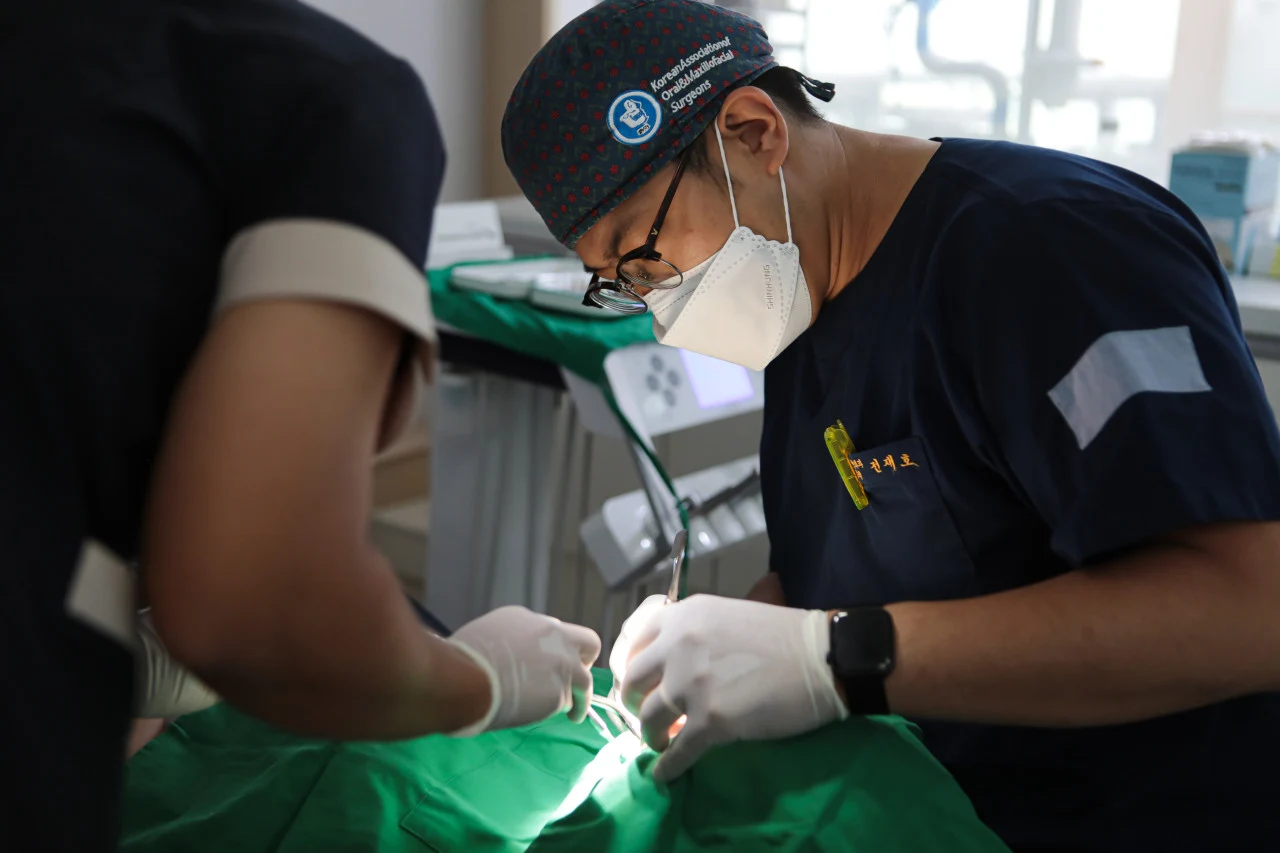
Hello! I am Dr. Jaeho Jeon, an Oral & Maxillofacial Surgeon at ARC Dental Clinic near Gwanghwamun, Seoul City Hall, Jongno, Euljiro, Myeongdong, and Cheonggyecheon. I am also a Visiting Professor at Seoul National University Dental Hospital, and I work tirelessly to perform implant surgeries, extract wisdom teeth, treat TMJ disorders, and most importantly, save natural teeth whenever possible.
The weather has been truly scorching lately. The word 'hot' hardly does it justice — the heat is so intense it feels like melting. Standing outside for even a moment at midday is enough to break a sweat. That is why I make every effort to keep the temperature and environment inside ARC Dental Clinic as cool and comfortable as possible the moment you step through our doors.
Not long ago, the news was filled with reports of record-breaking heatwaves in Europe, and now it seems that heat has reached Korea as well. I want to sincerely thank our patients who continue to trust ARC Dental Clinic and visit us despite this oppressive heat.
Dental Implants with Underlying Diseases: An Oral & Maxillofacial Surgeon's View
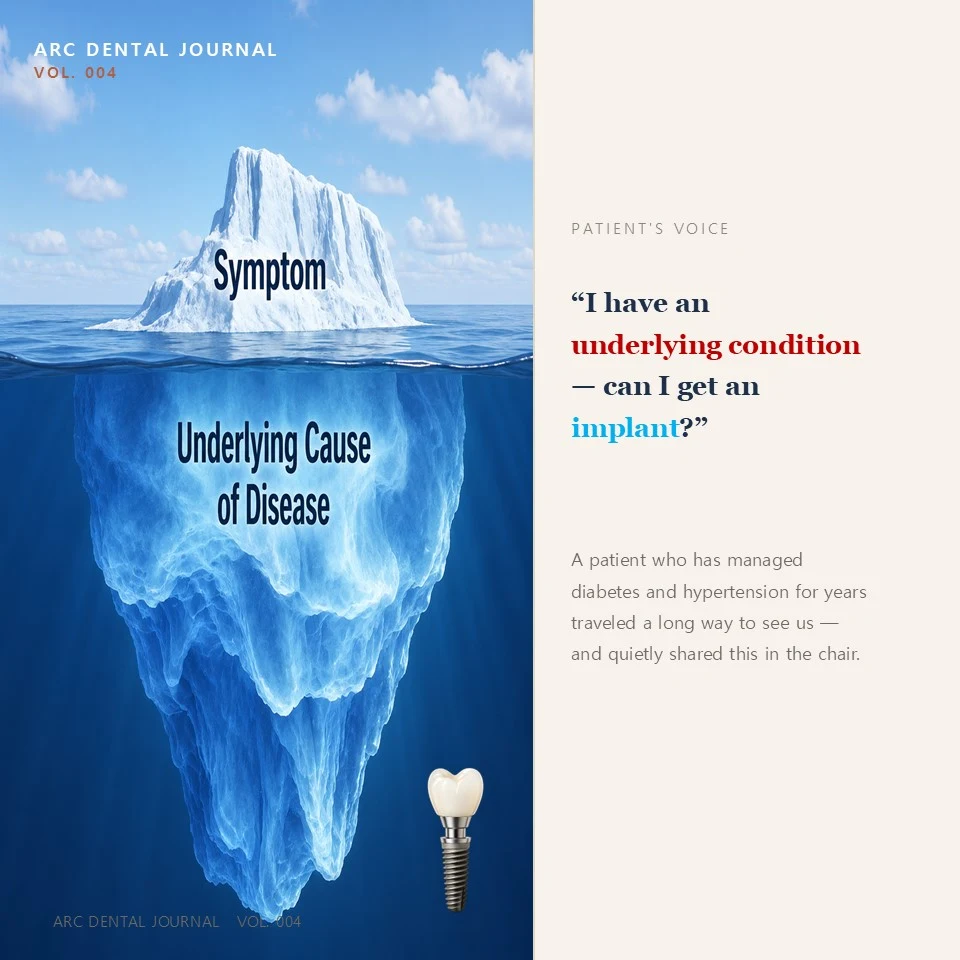
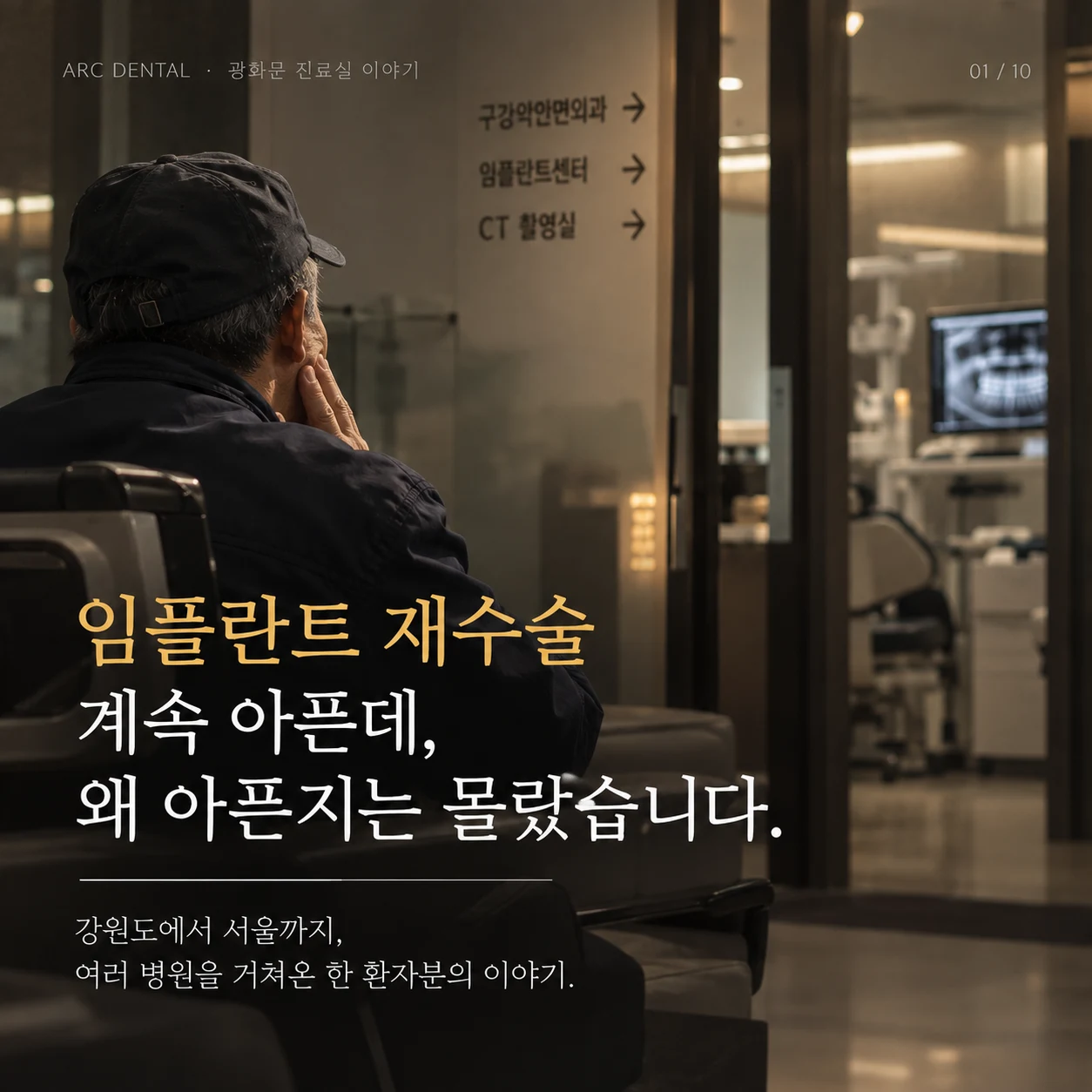
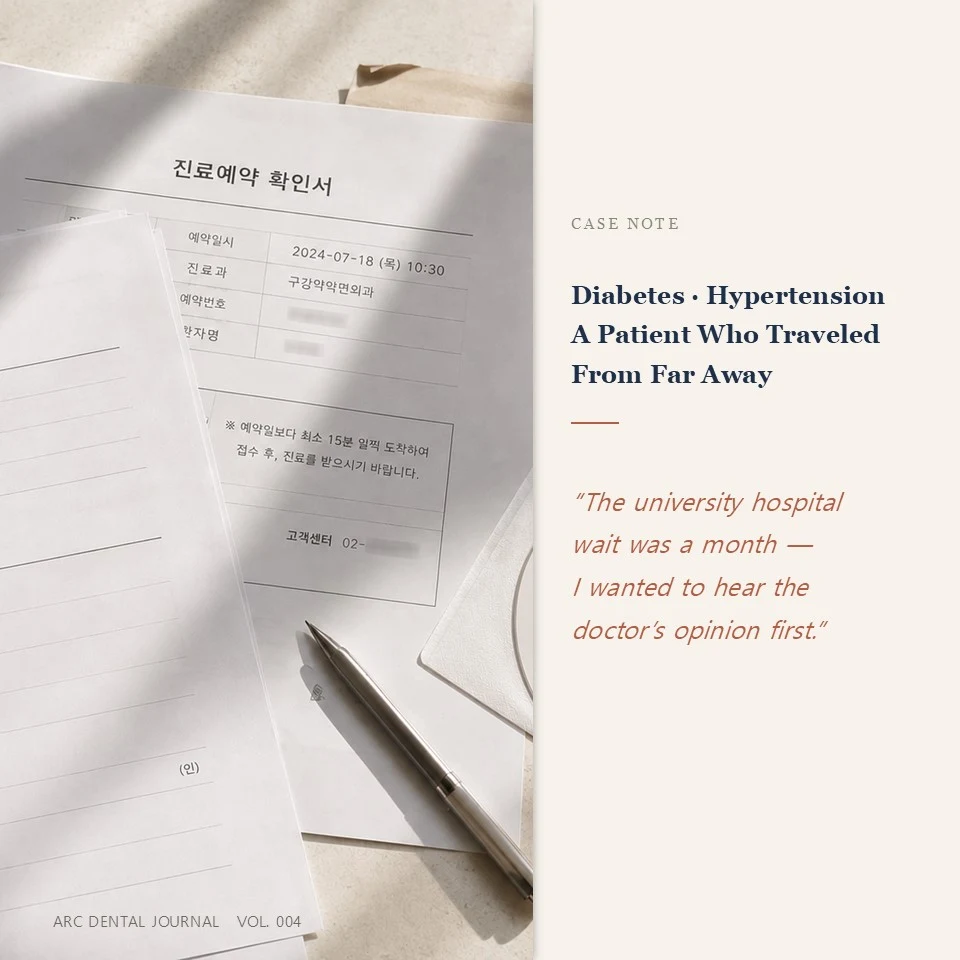
A few days ago, a patient visited from a distant area. Though not particularly old, they had been living with diabetes and hypertension for many years. While researching implant treatment, they had also considered going to a university hospital. However, they told me that getting an appointment was not easy — a consultation alone required a wait of 2-3 weeks, and factoring in the professor's consultation and actual treatment, it could take over a month. Rather than postponing treatment further, they came to ARC Dental Clinic wanting to hear an Oral & Maxillofacial Surgeon's opinion first.
I understand better than anyone why university hospital appointments take so long. During my time at Seoul National University Dental Hospital, the outpatient clinic was always full of waiting patients, and the professors' schedules were constantly packed. Oral cancer patients and complex surgical cases often faced even longer waiting times. I participated in oral cancer surgeries alongside several professors there.
Oral cancer surgery is a completely different world from routine dental care. Cases requiring reconstruction of the jawbone using the fibula after tumor removal could take dozens of hours for a single surgery. Being on the front lines, I witnessed firsthand how medical teams from multiple specialties put their heads together — from surgery to recovery — each doing their utmost for the patient. Every time, one thought arose: 'Korea's medical professionals are truly remarkable.'
While patients rest after surgery, the medical team immediately begins preparing for the next patient. I ran alongside them and learned many times that 'stamina is also a skill.' But what I learned even more deeply was this: a good doctor is not just someone who operates well, but someone who takes responsibility for their patients to the very end. Those experiences remain the standard for my practice today.
Now, I want to bring that university hospital experience and those principles directly to our patients at ARC Dental Clinic. So that the specialized care of an Oral & Maxillofacial Surgeon — which many assume is only available at university hospitals — can be accessed closer to home, and faster.
Cases like this are not uncommon. Even before opening ARC Dental Clinic in Gwanghwamun, I saw them more often than you would think. Some patients drove hours to reach me; others were referred by acquaintances. Looking at this patient who traveled so far in such sweltering weather, my first thought was one of gratitude: 'You trusted me enough to come instead of waiting.' I make it a point never to take that trust lightly. Thank you, truly.
Diabetes, Hypertension, and Dental Implants from an Oral & Maxillofacial Surgeon's Perspective
Back to the main topic. "You have come a long way in this heat — thank you. You must have had a lot on your mind." I began the consultation with these words. Sitting in the treatment chair, the patient asked: "Can I get implants even though I have underlying conditions?" "I am worried because of my diabetes." "I have been taking blood pressure medication. Can I also get implants like everyone else?"
What I find most disheartening in practice is how many people postpone or completely give up on implants simply because they have an underlying condition.
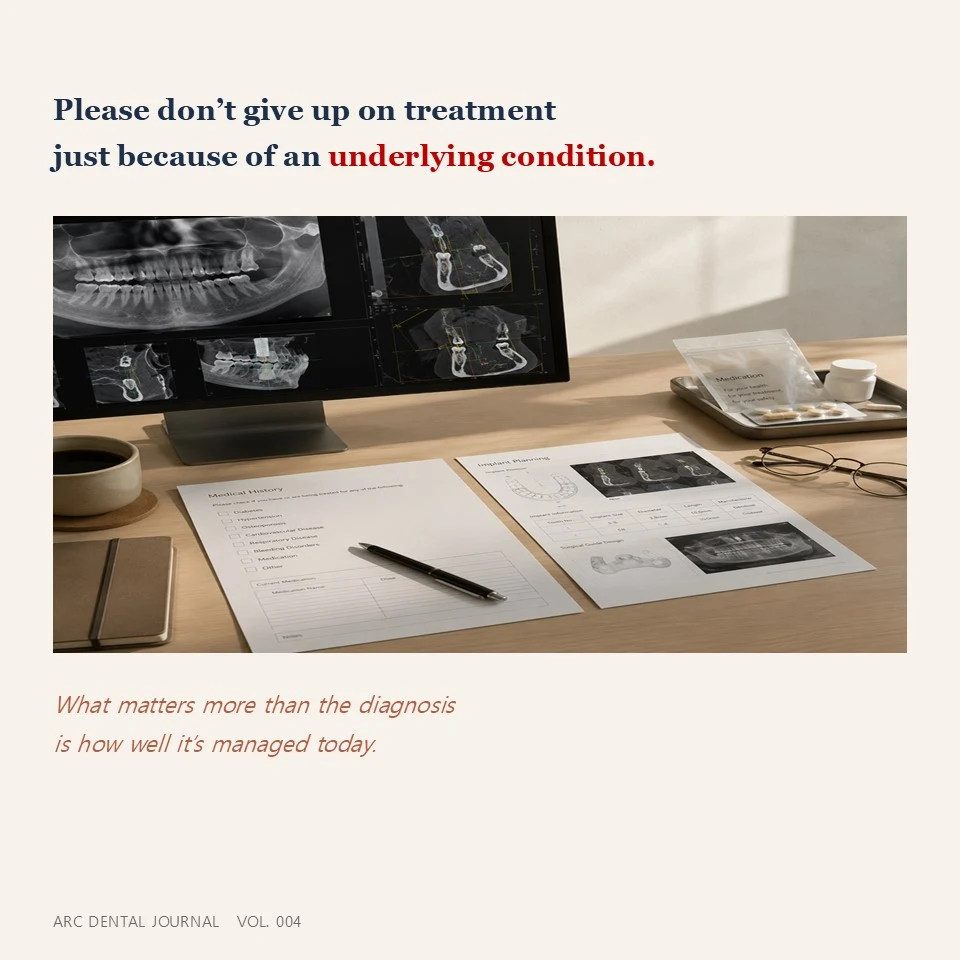
If You Have Underlying Conditions, Do Not Give Up on Implants. ARC Dental Is Here for You.
Patients with systemic conditions like diabetes, hypertension, or osteoporosis already invest immense time and effort into managing their health. With regular hospital visits, medication, and careful attention to diet and lifestyle, thinking about dental treatment on top of everything else can feel overwhelming. I understand that feeling completely. Thoughts like 'I should focus on my other health first,' 'I can manage by chewing on one side,' or 'Let me just hang on a bit longer' are completely natural.
But teeth are not just for chewing food. The pleasure of eating delicious meals comfortably, the joy of sharing a meal with family and friends, even proper nutritional intake — all of these are connected to your teeth. Neglecting a troublesome tooth can lead to one-sided chewing habits, placing greater burden on the remaining teeth and often causing new problems. I have seen many patients who initially had pain on only one side come back clutching their jaw because the other side had also developed issues.
That is why I recommend getting an accurate diagnosis of your current condition first, rather than giving up on implants from the outset just because of an underlying condition. In real clinical practice, what matters far more than the mere presence of an underlying disease is how well your overall health is currently managed, what medications you are taking, and whether treatment can proceed safely. A comprehensive assessment of these factors is much more important.
At our clinic, we always check a patient's underlying conditions and current medications before planning implant surgery. Some may wonder, "Do I really need to talk about my medications for dental treatment?" But implants involve surgery on the gums and jawbone. Your systemic health status and current medications are therefore crucial information for planning surgery. Whether your diabetes or hypertension is well controlled, whether you are taking medications that affect blood clotting, or whether you are receiving osteoporosis treatment — all of these can change what needs to be confirmed before surgery and how the treatment plan is designed.
So even if the medical history form seems to have many questions about conditions and medications, I hope you will not find it bothersome. These are not questions to simply fill in blanks on a form, but part of the process of planning treatment that is tailored to your health status for a safer surgery. If you cannot remember the name of your medication, that is perfectly fine — just bring the medication packet or a photo on your phone, and we will check it together. Only by understanding not just your dental condition but your overall health can we build a more careful and stable implant treatment plan.
Having an underlying disease does not mean implants are always difficult. A question I frequently hear in the consultation room is, "So if I have diabetes, is an implant difficult?" My answer is always the same: "What matters more than the name of the disease is how well it is currently managed." For example, you cannot categorically say that a diabetic patient with well-controlled blood sugar is worse off than a patient with no underlying conditions who smokes heavily and has poor gum health. Implant treatment is never decided based on a single factor.
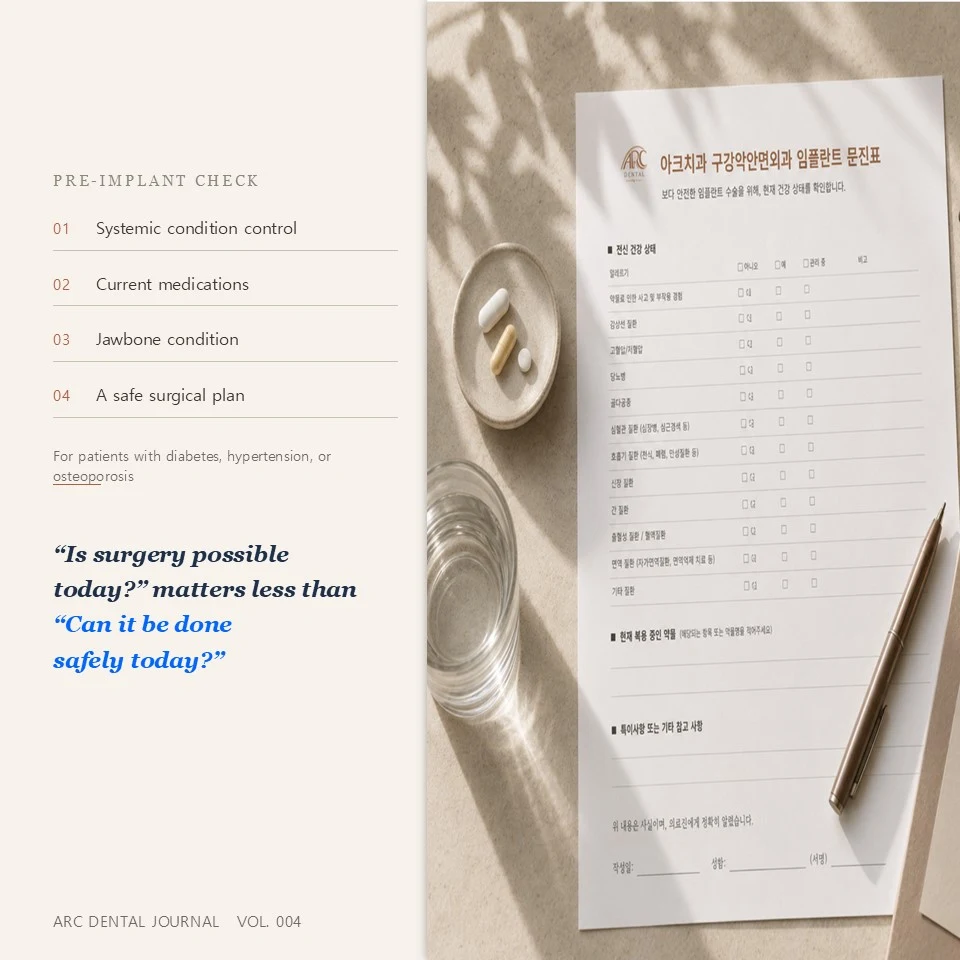
When Planning Implants, Oral & Maxillofacial Surgeons Evaluate Multiple Factors Together:
- Current control status of systemic diseases
- Medications being taken
- Blood pressure and blood sugar management
- Jawbone quantity and quality
- Presence of inflammation
- Periodontal condition
- Bite force and occlusion
- Future maintenance feasibility
After comprehensively evaluating these factors, we develop the most appropriate treatment plan. That is why I rarely tell patients, "You cannot get implants because of your underlying condition," or "You are fine, let us proceed with surgery right away." First, we accurately assess your current health and thoroughly evaluate whether treatment can proceed safely.
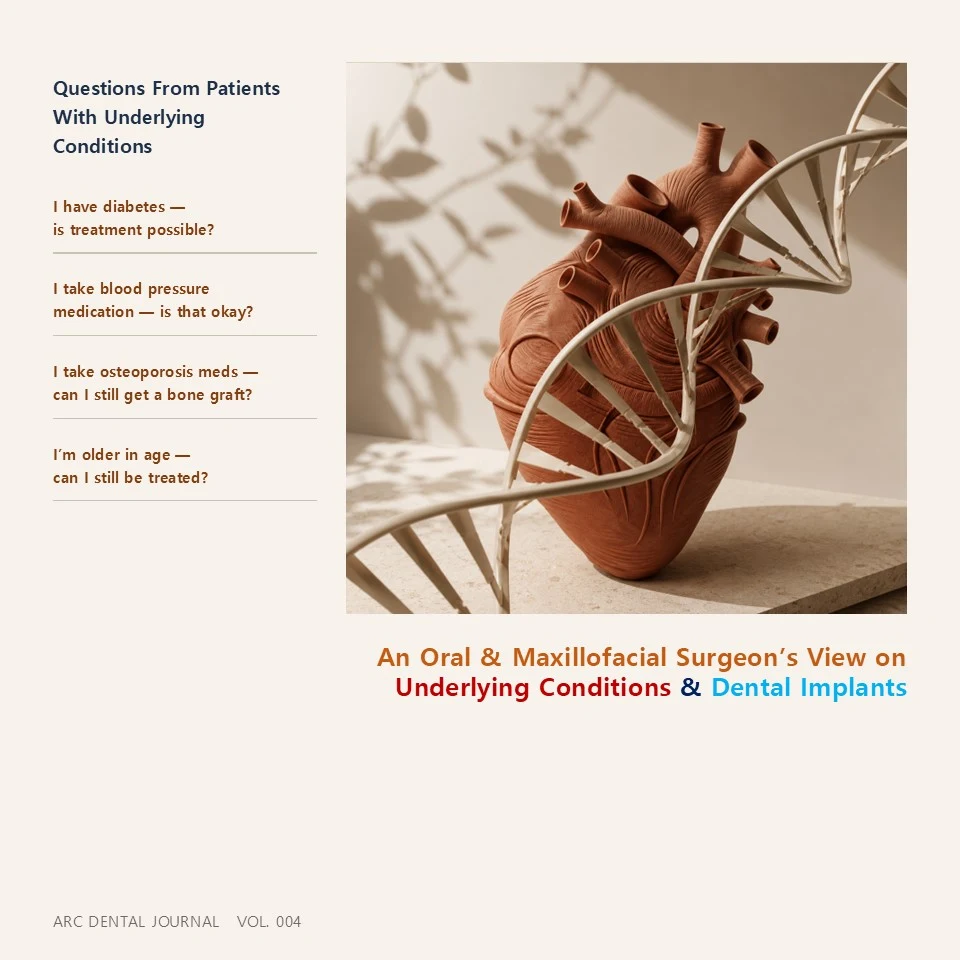
Common Questions About Implants and Underlying Conditions
In consultations, questions generally fall into four main categories:
- Can I get implants if I have diabetes?
- Is it safe to undergo surgery while taking blood pressure medication?
- Can I have a bone graft while on osteoporosis medication?
- Can elderly patients still receive implant treatment?
I suspect many who found this article through a search share similar concerns. Let me now walk through each condition one by one — what we check in the clinic and what aspects we consider most important.
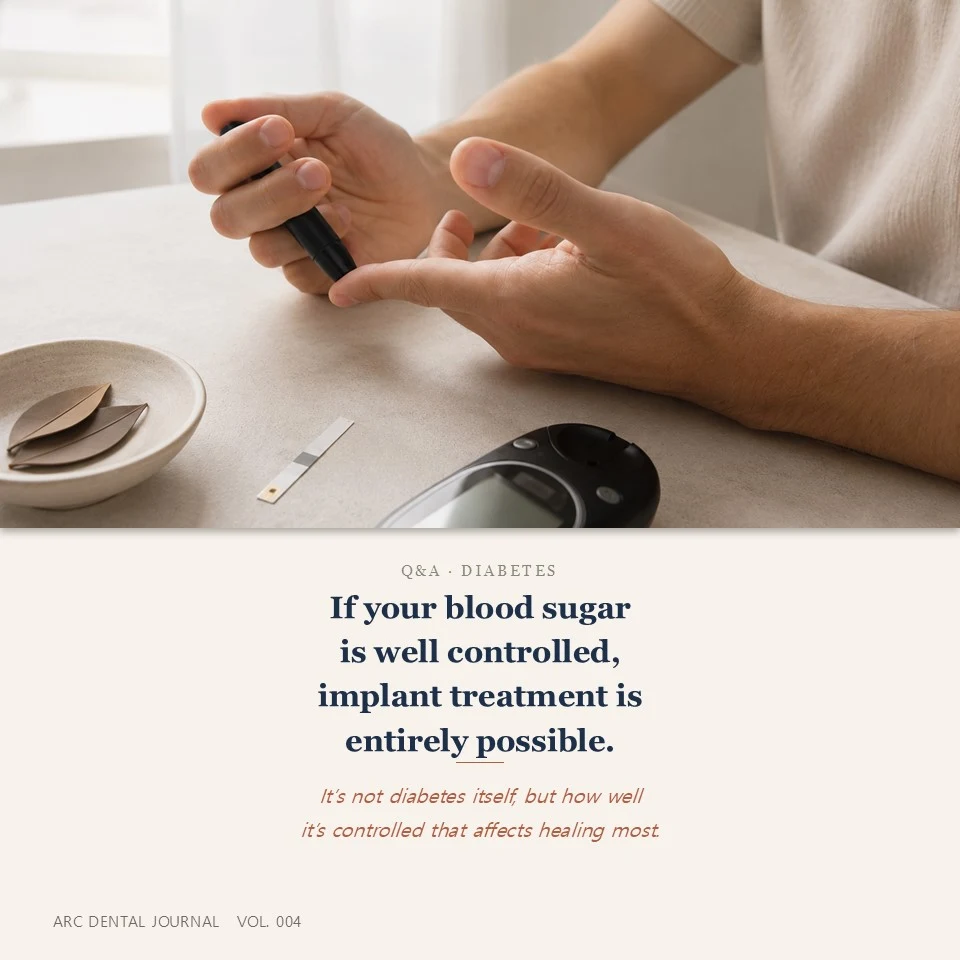
1. Can I get implants if I have diabetes?
This is probably one of the most frequent questions. The short answer: having diabetes does not automatically mean you cannot get implants. What I check first is something else entirely. "How well is your blood sugar controlled these days?" "What was your most recent HbA1c?" "What medications are you currently taking?" I ask these questions first because how stably your blood sugar is managed has a far greater impact on wound healing and infection risk than the mere presence of diabetes.
In practice, I have seen many patients with well-controlled blood sugar maintain their implants excellently. Conversely, a patient without diabetes who smokes heavily or has poor gum health may require a more cautious approach. That is why, rather than saying "you cannot because of your diabetes," I far more often say, "Let us first check your current blood sugar status."

2. Is it safe to have surgery while continuing blood pressure medication?
After diabetes, this is the second most common question. Many patients sit down and immediately ask, "Doctor, I have been on blood pressure medication for 10 years — is surgery safe for me?" or "Is anesthesia dangerous if I have hypertension?" Many people seem to believe that hypertension equals being unable to have surgery. In reality, that is not the case.
What I check first is not the fact of having hypertension, but how stably the blood pressure is currently controlled. If blood pressure is well managed with consistent medication, we often proceed with implant treatment. On the other hand, if you are not taking your blood pressure medication or if your blood pressure has recently been significantly elevated, stabilizing it takes priority. So during the consultation, we check your blood pressure and, if needed, also review your current medications and recent health status.
One thing that often surprises patients: You must not stop taking your blood pressure medication on your own before coming in. Occasionally, patients read online and say, "I did not take my blood pressure medicine today because of the surgery." This can actually make blood pressure more unstable, so in most cases, it is better to take it as usual and come in. Of course, there are special situations where consulting your internist may be needed.
When I plan implant surgery, I always think: 'Can we do this safely?' rather than just 'Can we do this today?' That difference matters more than you might think. So rather than giving up on treatment just because of hypertension, the first step is to check how well your blood pressure is currently managed. Hypertension is not an absolute contraindication for implants — it is simply one of the factors we must consider to plan treatment more safely.

3. Can I have a bone graft while on osteoporosis medication?
I hear this question very frequently, especially from female patients. "Doctor, I have been on osteoporosis medication for a long time and was told I cannot get implants. I also need a bone graft — is that okay?" When I hear this, my first response is: "First, let me check which medication you have been taking and for how long." Not all osteoporosis treatments are the same.
The type of medication, the duration of use, and whether you are currently taking it or have already stopped — all of these can change the treatment plan. So we cannot conclude that "you cannot get implants because of osteoporosis." However, these cases do require a more cautious approach. Long-term use of certain medications can slow bone healing, and in rare cases, there have been reports of complications in the jawbone healing process or insufficient osseointegration of implants.
We evaluate the type and duration of medication, bone density and jawbone condition, and whether a bone graft is needed — then build a comprehensive treatment plan. Some osteoporosis medications, in particular, require even more careful evaluation when planning bone-related procedures like extractions or implant surgeries.
Of course, not all osteoporosis patients cannot receive implants. What matters more is informing us upfront that you are taking medication, and then considering your oral condition and overall health together to plan the safest possible treatment. That is why I strive to diagnose more carefully and plan more meticulously, especially for patients on osteoporosis medication. During consultations, I always ask one thing: "If you know the name of the medication you are taking, please let me know." Simply bringing your medication packet or a photo of it is a tremendous help in planning your treatment. Ultimately, what matters is not 'whether you have osteoporosis' but 'which medication you are taking and how.'

4. Can elderly patients still receive implant treatment?
I also get this question very often, frequently from family members and caregivers first. "Is it okay at their age?" "Can they still get implants at this stage of life?" Recently, a grandmother in her 80s underwent implant surgery at our clinic. Honestly, when I first looked at the chart and saw her age, I felt a little nervous too. 'Will she be okay at her age?' 'Will she struggle during surgery?' Many may find it surprising, but as a surgeon, these are always the first questions I ask myself before any procedure.
But after actually meeting and consulting with her, my concerns gradually faded. Her blood pressure was well managed, her diabetes was stable, and she exercised regularly and ate well. Most of all, there was a healthy vitality about her as she sat in the treatment chair. She has since undergone surgery successfully, and her recovery is progressing smoothly. That experience reinforced something I already knew — the saying 'age is just a number' is only half true in medicine.
What matters is not the age on your ID card, but how healthily your body is currently being managed. I have seen patients in their 60s whose overall health requires a more cautious approach, and patients in their 80s whose excellent health management allows treatment to proceed as planned. That is why I do not judge implant candidacy by age alone. I assess current health status, current medications, heart and lung function, and whether surgery can be safely performed — one by one — before formulating a treatment plan.
Sometimes patients say, "Implants at my age? What is the point?" My response is always: "Instead of giving up because of age, let us first find out what is possible given your current health."
There is no retirement age for the joy of chewing delicious food.
And truly, the world is full of delicious food. A warm bowl of galbitang, crispy fried chicken, chewy samgyeopsal, a refreshing bowl of naengmyeon... If dental discomfort prevents you from freely enjoying the foods you love, few things could be more disheartening. The 'joy of eating' is a greater happiness in life than we often realize.
I believe that implants are ultimately a treatment that helps patients smile comfortably and eat comfortably again. As we age, chewing well and eating well become even more critical for maintaining health. So I hope you will not give up on implants simply because of your age. The best approach, I believe, is to first receive an accurate diagnosis of your current condition and then decide together, based on those results, how to proceed with treatment.
Systemic Conditions, Underlying Diseases, and Dental Implants
This was an implant story I have been wanting to share for a while, and it has grown quite long in the telling. I started out thinking 'let me just explain this one thing,' and before I knew it, I had gone from diabetes and hypertension all the way to osteoporosis and age.
If you have made it all the way through this long article, I sincerely thank you. At this point, it might feel as though you have already come to our clinic and had an implant consultation with me.
Though this was a long read, I hope it has been at least a little helpful to those hesitating about implant treatment due to underlying conditions or age. Rather than worrying or giving up on your own, please first check accurately whether there are treatment options possible given your current health.
Because there is no retirement age for the joy of chewing delicious food comfortably.
This has been Dr. Jaeho Jeon — Oral & Maxillofacial Surgeon at ARC Dental Clinic near Gwanghwamun, Jongno, Euljiro, Myeongdong, Jonggak, and Cheonggyecheon; SNU-trained Oral & Maxillofacial Surgery Specialist; and Visiting Professor at Seoul National University Dental Hospital. Stay healthy in this sweltering heat, and I hope you have a cool and comfortable day!!
\n\n